FEDERATED NETWORK
AI Structural Biology (AISB) Network
An industry-led collaboration of nine leading pharmaceutical companies, formed to advance AI for drug discovery.

FEDERATED NETWORK
An industry-led collaboration of nine leading pharmaceutical companies, formed to advance AI for drug discovery.
WHY THE NETWORK EXISTS
One major challenge in advancing AI for drug discovery is the limited availability of protein and ligand structural data suitable for training models that perform in industrial settings. Public databases are commonly acknowledged as insufficient for the precision required in drug discovery portfolios.

Few public structures contain a drug
Co-folding models are trained on public structural data, above all the Protein Data Bank (PDB), the main public archive of experimentally determined protein structures. It holds more than 240,000 of them. Only about 10,600 contain an approved or investigational drug, and only about 3,000 of those were added after AlphaFold3’s training cutoff.

Reduced accuracy on drug-relevant complexes
Public benchmarks look solved: AlphaFold3 places more than 75% of ligands within 2 Å on PoseBusters, and Boltz-2, Protenix and Chai-1 report comparable results. Accuracy drops on what drug discovery depends on: antibody–antigen complexes, and drug-like ligands on targets that public data barely covers.

Relevant data exists but cannot be shared
Pharmaceutical companies have accumulated large proprietary datasets of protein–ligand complexes over decades of research. This data remains siloed due to intellectual property, confidentiality and regulatory constraints.
Sources: RCSB Protein Data Bank holdings, 2026; Abramson et al., Nature, 2024; Buttenschoen et al., Chemical Science, 2024 (PoseBusters); Boltz-2, Protenix and Chai-1 technical reports.




PROVEN IN THE FIRST INITIATIVE
In the Federated OpenFold3 Initiative, five member companies jointly fine-tuned OpenFold3 in under ten weeks, in collaboration with the AlQuraishi Lab at Columbia University, and without sharing any underlying data. The resulting model outperforms every public model tested, and any model fine-tuned on a single partner’s data alone.
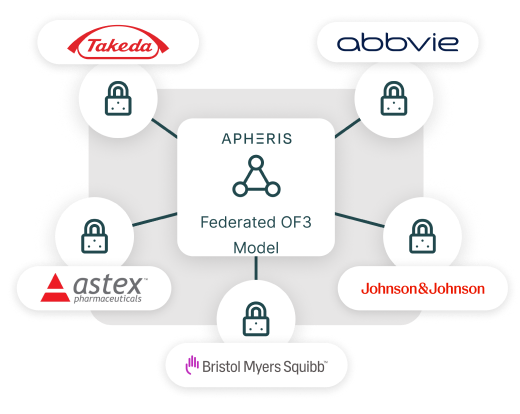
Five member companies contributed proprietary structures.
AbbVie, Astex Pharmaceuticals, Bristol Myers Squibb, Johnson & Johnson and Takeda each fine-tuned OpenFold3 locally, inside their own environment. Only model parameters were aggregated. No structures were pooled.
20,000+
private structures from active drug-discovery programs, roughly tripling the drug-relevant data available for training
+11 pts
lead over the strongest public model tested, on both accuracy metrics
<10 weeks
from first federated training run to a state-of-the-art model
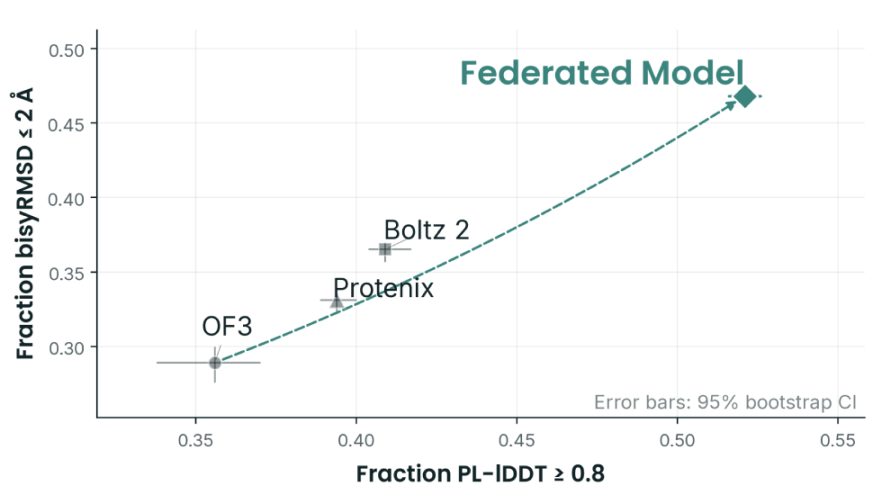
Ahead of every public model tested, on both measures.
+10 pts pose accuracy
+11 pts interface quality
Axes: fraction of structures with PL-lDDT ≥ 0.8 and fraction with bisyRMSD ≤ 2 Å, on 1,056 held-out private structures from five pharma partners, ranked selection. AISB-1-Fed also outperformed every model fine-tuned on a single partner’s data alone.
Read the full resultsAISB BIND · IN PROGRESS
AISB Bind extends the approach from structure to binding prediction.
AbbVie, AstraZeneca, Bristol Myers Squibb, and Johnson & Johnson will collaboratively train an AI model to predict how small molecules bind to their protein targets, accurately enough to guide two high-leverage steps in early drug discovery: virtual screening and lead optimization.
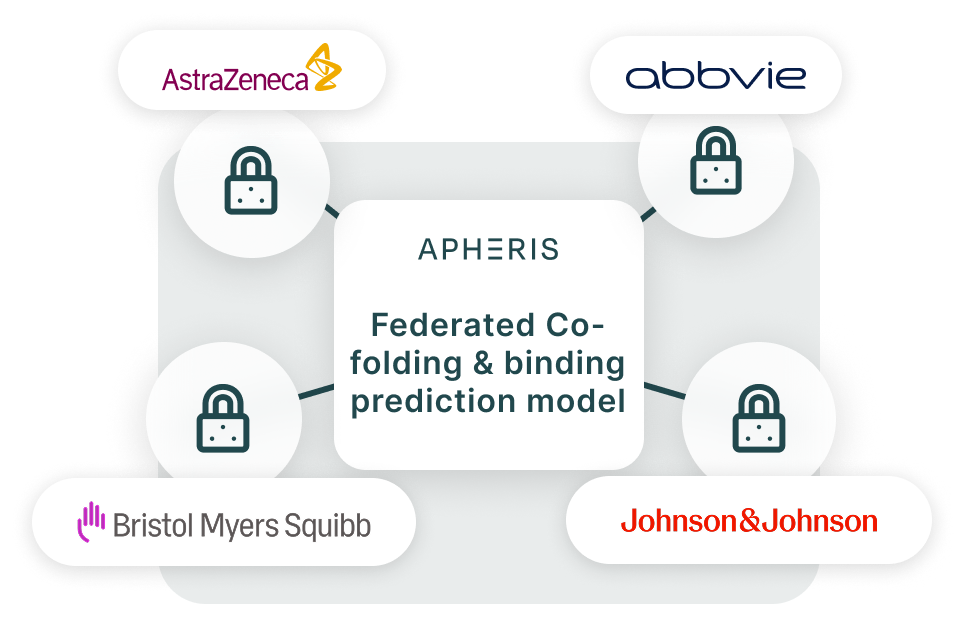
The four founding partners collectively contribute three complementary types of data.
Experimentally determined structures, quantitative affinity and potency measurements, and high-throughput screening activity data. Because training runs through federated learning, each partner's proprietary data stays within its own secure environment and is never exposed to others.
Read the announcementIN THE PRESS

Apheris Announced the Results of their Federated Learning Co-Folding Initiative – Now Four Big Pharma Are Betting Bigger

Drug firms’ secret data supercharge AI protein models

The AI model OpenFold3 takes a crucial step in making protein predictions
HOW THE NETWORK WORKS
The Network operates through initiatives: collaborations among members on a specific use case, across both small and large molecules.
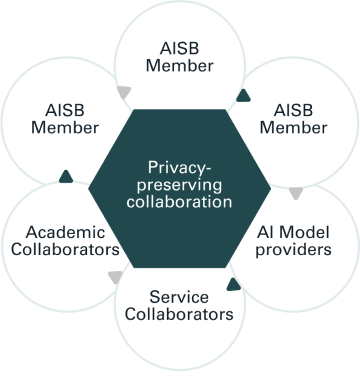
Participation is per initiative.
Each initiative brings together the members whose scientific priorities it matches. Members who take part receive the resulting model.
Models can come from anywhere.
Initiatives can build on models from academic labs, private model providers or the open-source community.
WHY MEMBERS CONTRIBUTE

Data never leaves.
Training runs inside each member’s own environment. Only privacy-preserving model updates are aggregated into the global model.

Custodians control computation.
Data custodians define access policies governing which computations may be trained or evaluated on their data.

Models are attack-tested.
ML-attack-based validation confirms that trained models do not leak sensitive information or permit reverse engineering of proprietary data.

Members own the models.
Background and foreground IP are separated by contract. The weights of the model an initiative produces belong to the participating members.
THE ROLE OF APHERIS
Neutral by design.
Apheris provides the federated technology, streamlines the scientific discussions and alignment across pharma companies, the project planning, and the contracts and approvals.
INITIATIVES
The first initiative is complete. What follows is selected on scientific significance and strategic value to members.
DELIVERED
The Federated OpenFold3 Initiative
Five member companies jointly fine-tuned OpenFold3 across more than 20,000 proprietary structures, run with the AlQuraishi Lab at Columbia University. Protein–protein interface quality improved significantly as a by-product, without being optimized for.
ACTive
The AISB Bind Initiative
Four founding members are training one shared model to predict how tightly small molecules bind their targets, extending the network from structure to binding. It draws on structures, affinity and screening data that never leaves any company, built for virtual screening and lead optimization.
OPEN
Bring your own priorities
If the problem blocking your programs is not on the roadmap yet, it can be. Initiatives are shaped around the scientific priorities of the members taking part.
OUR COLLABORATIVE VISION
Towards in-silico precision approaching X-ray crystallography.
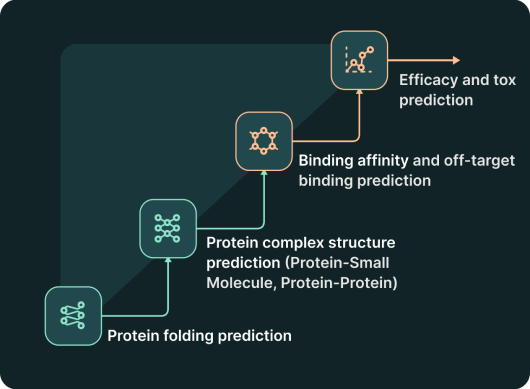
The AISB Network uses secure federated learning to protect both data privacy and model performance, with the long-term goal of accelerating AI in molecule design by reaching a precision in predicted protein complex structures that approaches X-ray crystallography.
Reaching that precision depends on four things:

Data available for training while preserving confidentiality and IP
Infrastructure for federated learning and high-performance compute
Leading-edge AI algorithms
Partnership between pharma and technology
AI-powered drug discovery changes materially once data from multiple pharmaceutical companies can be used jointly to train the models that in-silico discovery depends on.
Get the AISB Network overview
Download the detailed overview for how the Network is structured and what participating in an initiative involves.

FAQ
Frequently asked questions about AISB.
JOIN OUR NETWORK
Join the AI Structural Biology Network
Members take part in the initiatives that match their scientific priorities and receive the models those initiatives produce. We will come back to you to arrange an introductory conversation.


